Hello Humans! I’m back on Lopez Island for a week, reuniting with Thick and Karen and the rest of the crew here, doing laundry, organizing gear, trying not to let anxiety get the best of me. Feeling grateful for the familiar routines of my home for the past almost 9 years. Kari Feeney drove up from Scapoose, Oregon with me to spend some time with Finley and Temekin (the ‘Stangs!) in preparation for her PCT Long Ride.
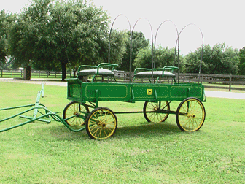 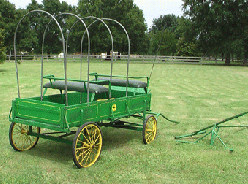 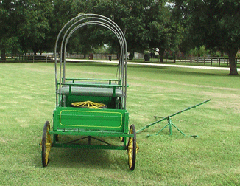 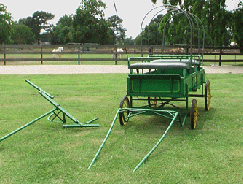 |
When I was quite young, I became obsessed with Little House on the Prairie. My mom made me a hoop skirt and a sun bonnet and my folks allowed me to drive a young pony named Dolly hitched to a wagon much like the one pictured above to church on many a Sunday morning. (Who knows, maybe even the same one – this one is about the right vintage and was sold out of Texas back in the 80s) My little sister rode shotgun, we were on real country roads in East Texas, this was way before cell phones, I was maybe 12? The wagon had a canvas top – a mini sized covered wagon – I was living out my pioneer fantasy life and for once I didn’t complain about having to attend services. I’m sorry I don’t have a photo of that set-up, but it’s vivid in my memories. Those memories are strongly influencing the current adventure.
The combined weight of Franklin and Theodore (my ponies) is around 800#. That means that I need to keep the combined weight of the wagon, me, Thick (my Corgi), gear and food and everything I need to travel down the road to less than 800#. Horses and ponies can pull much more than they can carry, but there’s no need to max them out – and going up a hill there’s just some basic physics involved. I weigh around 200#, which is the weight of 25 gallons of water, so this leaves open the possibility of me getting out to walk if we do need to carry water for a couple of days, or if the terrain is hilly or rough. Ideally, the wagon itself weighs around 400-450# max.
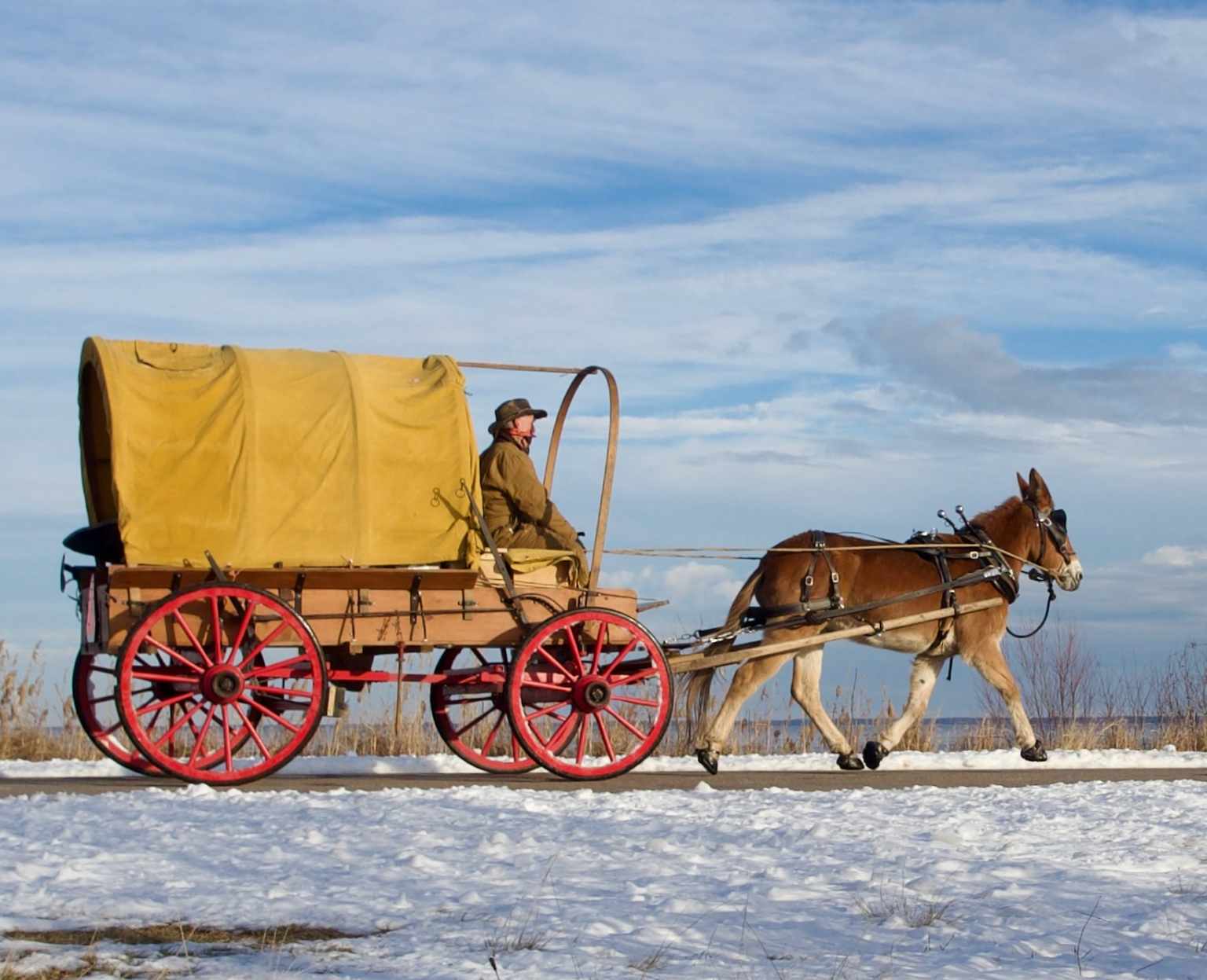
This picture is snagged from the RiverEarth website of Bernie Harberts, a member of the Long Riders’ Guild and also a Long Driver – he’s agreed to mentor me a bit as I get things pulled together. Bernie did a Long Drive with his good mule Polly from Saskatchewan to the Mexico border and made a 4 part documentary about it (The Lost Sea Expeditions, you can watch it on Prime – absolutely worth the few bucks) and then made another beautiful documentary in his home state of North Carolina, A Mule, a Covered Wagon and an Adventure Like No Other that’s free to watch on YouTube. Here’s a bit of his advice “Whatever cart or wagon you decide on, make sure that parts like bearings, wheels and brakes are available. Either easy to get (like Napa) pre-bought or preorganized to ship by vehicle manufacturer. This really helped me get through the inevitable breakdowns as quickly as possible.” This means that the romantic old time wooden wagon wheels are a non-starter. Also they are very heavy. Like 50# each for small ones. Car tires are likewise very heavy. So I have spent quite a bit of time researching the sort of tires that go onto off-road bicycles and motorcycles, learning about things like tubeless tires, green slime, bacon strips and kevlar liners.
If you’re interested, Bernie and I had a conversation (I asked a lot of questions and he answered as many as he could) on his TravelGrit podcast website – that link should take you there. On the same page there’s also an interview with Gin about her ride with Fable across Australia, and chats with several other assorted adventurers (including sail boats and even a hydropod!)
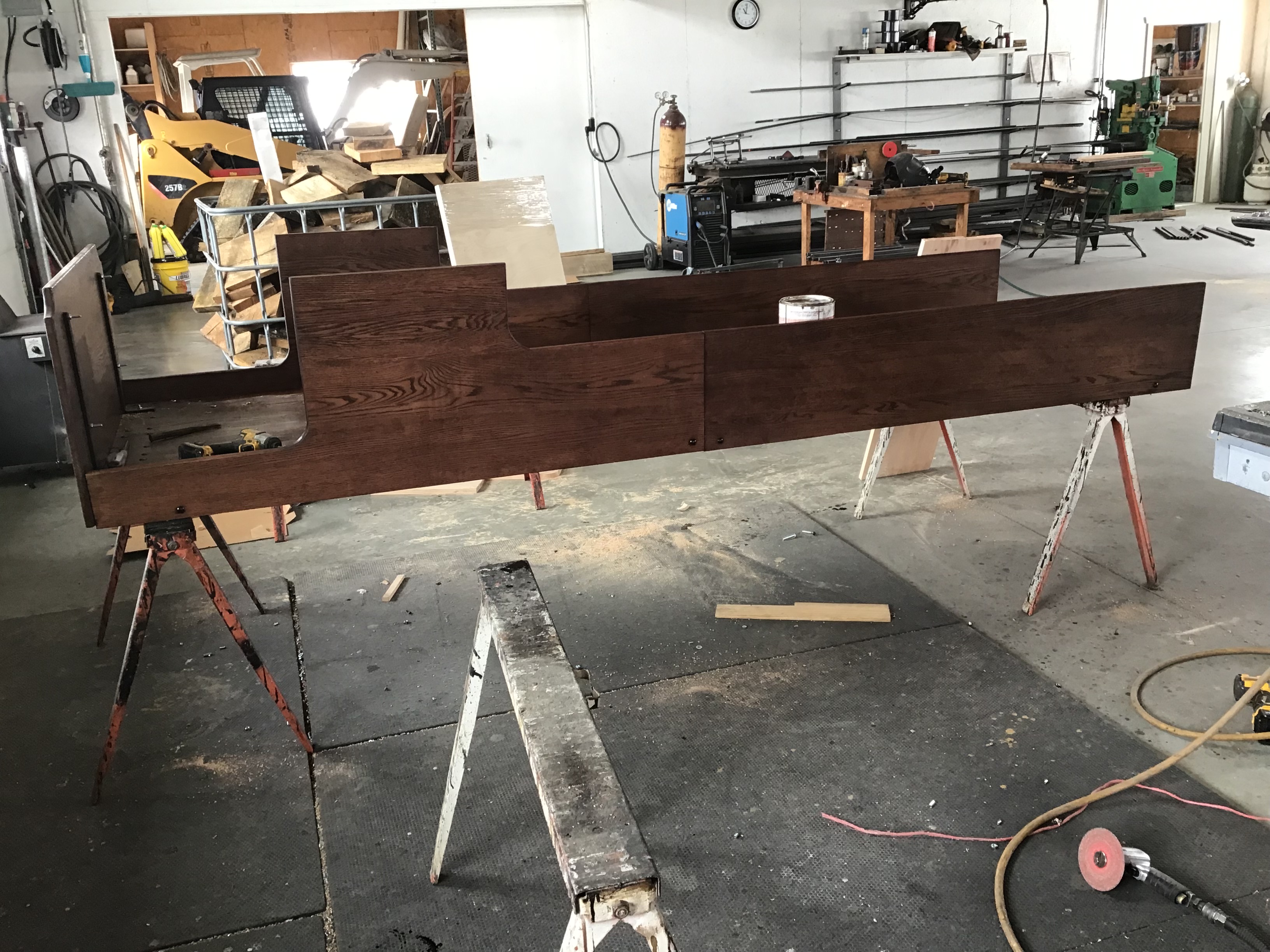
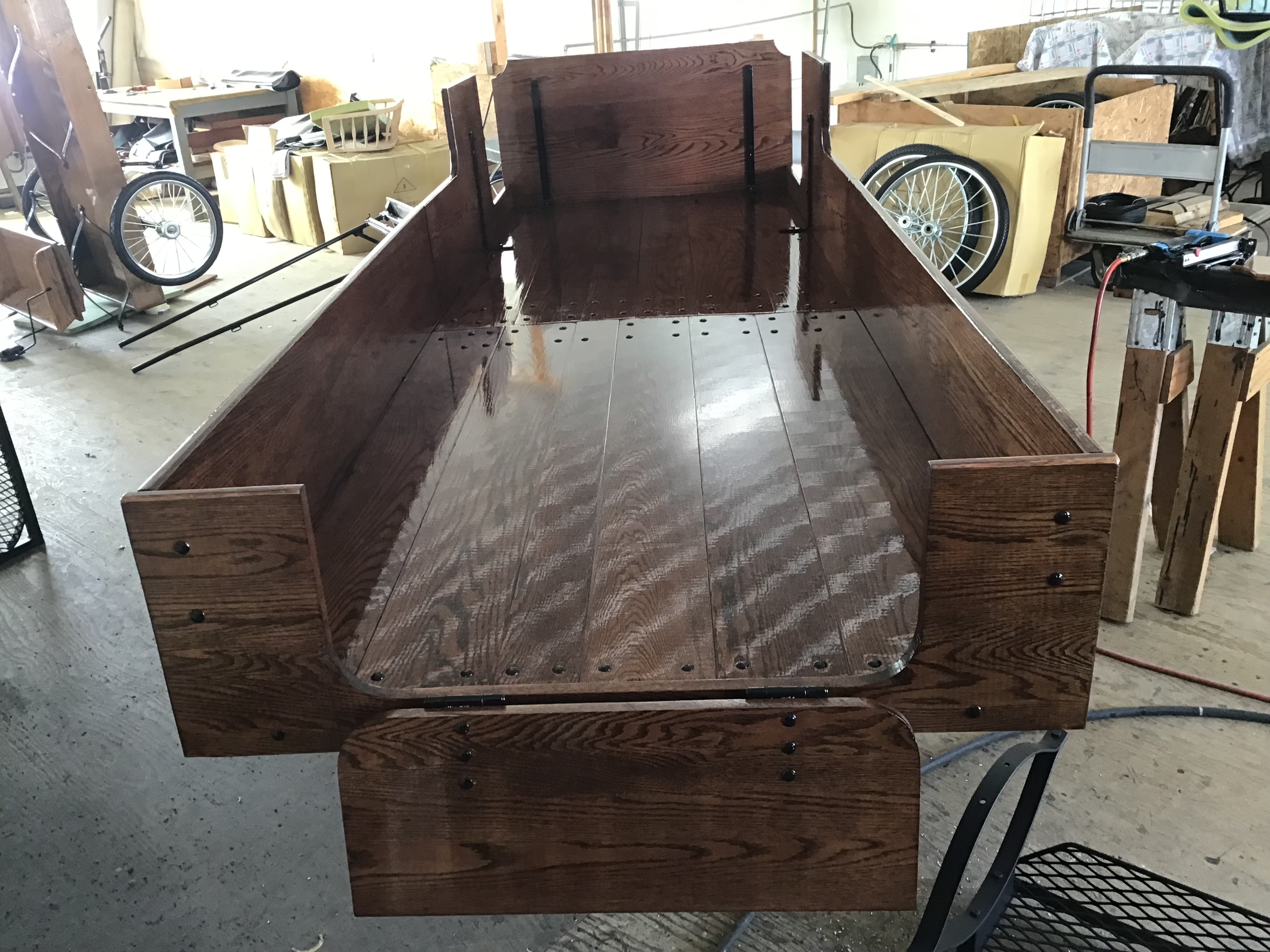
So – why a wagon this time? Because of my health situation and need for frequent resting I’ve decided that my best bet is to have my bed along, already set up in the back of the wagon and waiting whenever I need it. I want to be able to unhitch the ponies, get them sorted with graze and water, and then go lie down as quickly and efficiently as possible. On a long journey like this, setting up and breaking down camp every day gets exhausting pretty quickly even for people who are half my age (I did 750 miles on the AT at 35 and learned that lesson to my bones.) On my Long Ride, not having to set up my tent and bedroll was one of many reasons I was incredibly grateful for the frequency with which I was invited into people’s homes and offered a “real bed.” This time, because my immune system is barely functioning (and if I get sick it’s a lot harder to take care of my herd) I’m not going to be able to avail myself of that sort of hospitality. These days I don’t tend to go inside with other people unless I have a mask on. There’s plenty of room in the great out doors to meet and greet and socialize!
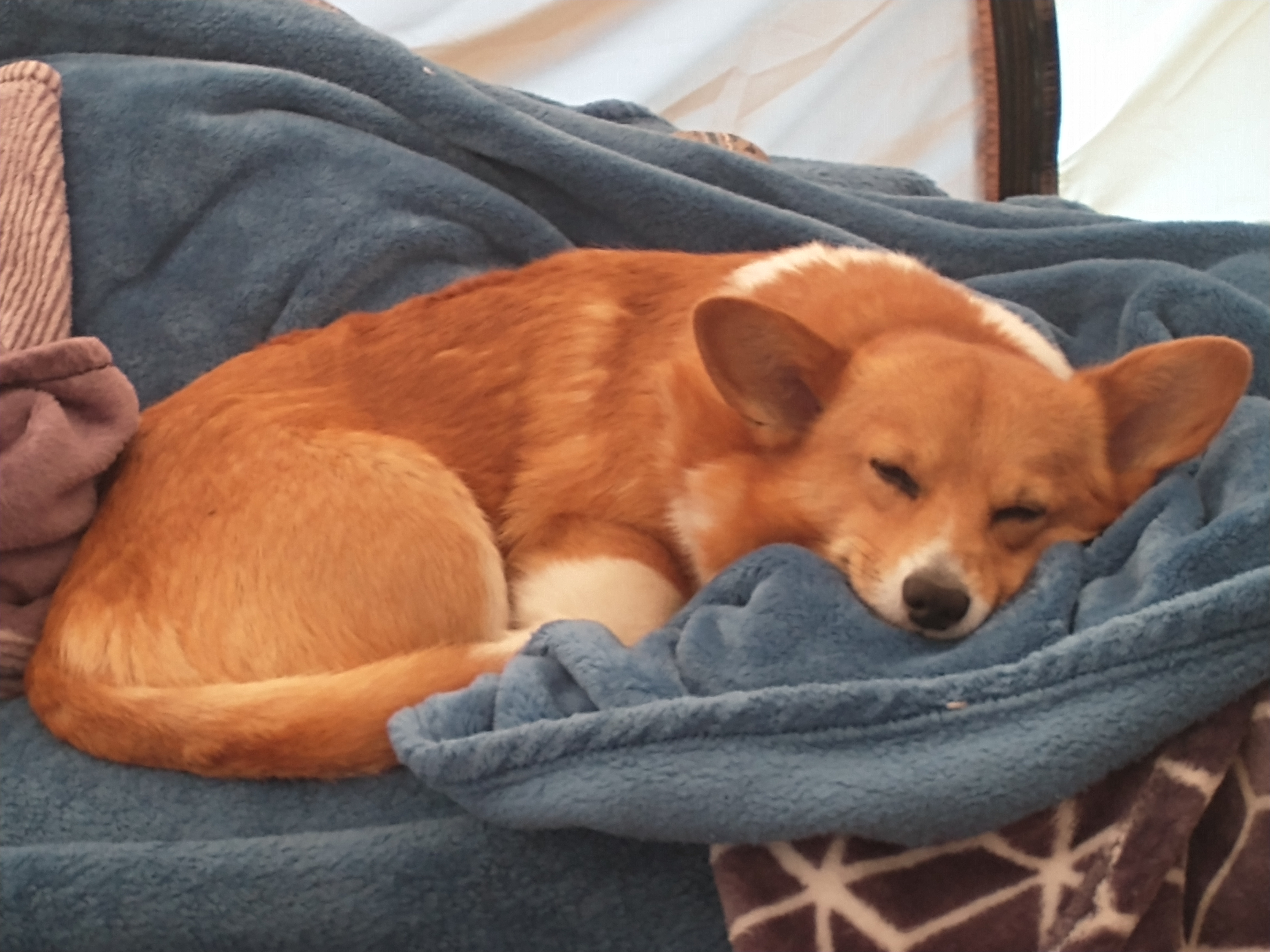
Along with the ponies, I’ll be traveling with Thick, my long-tailed Pembroke Corgi. He’d rather be out camping than anywhere else and the wagon will be his home, as well as mine. When I got home after a few months away from Thick (the longest we’ve been apart since he was a wee puppy) I was a bit shocked by how small he is! The wagon bed is only about 14″ off the ground, in part so that Thick can get in and out by himself. I’m going with a bench seat rather than a bucket seat so he can co-pilot. He’s got a very strong herding instinct so it’s going to be interesting to see how he feels about simply sitting in the wagon while the ponies are moving out in front of him.
More days than not I’m on the phone with Mel at Pequea Carriage Shop working on the wagon design details – last night it was the seat back. Monday the cart will go 12 miles down the road E&M Tarp Shop so Elam can figure out the cover for the Covered Wagon. Exciting times, honestly – when I don’t think about April too hard!
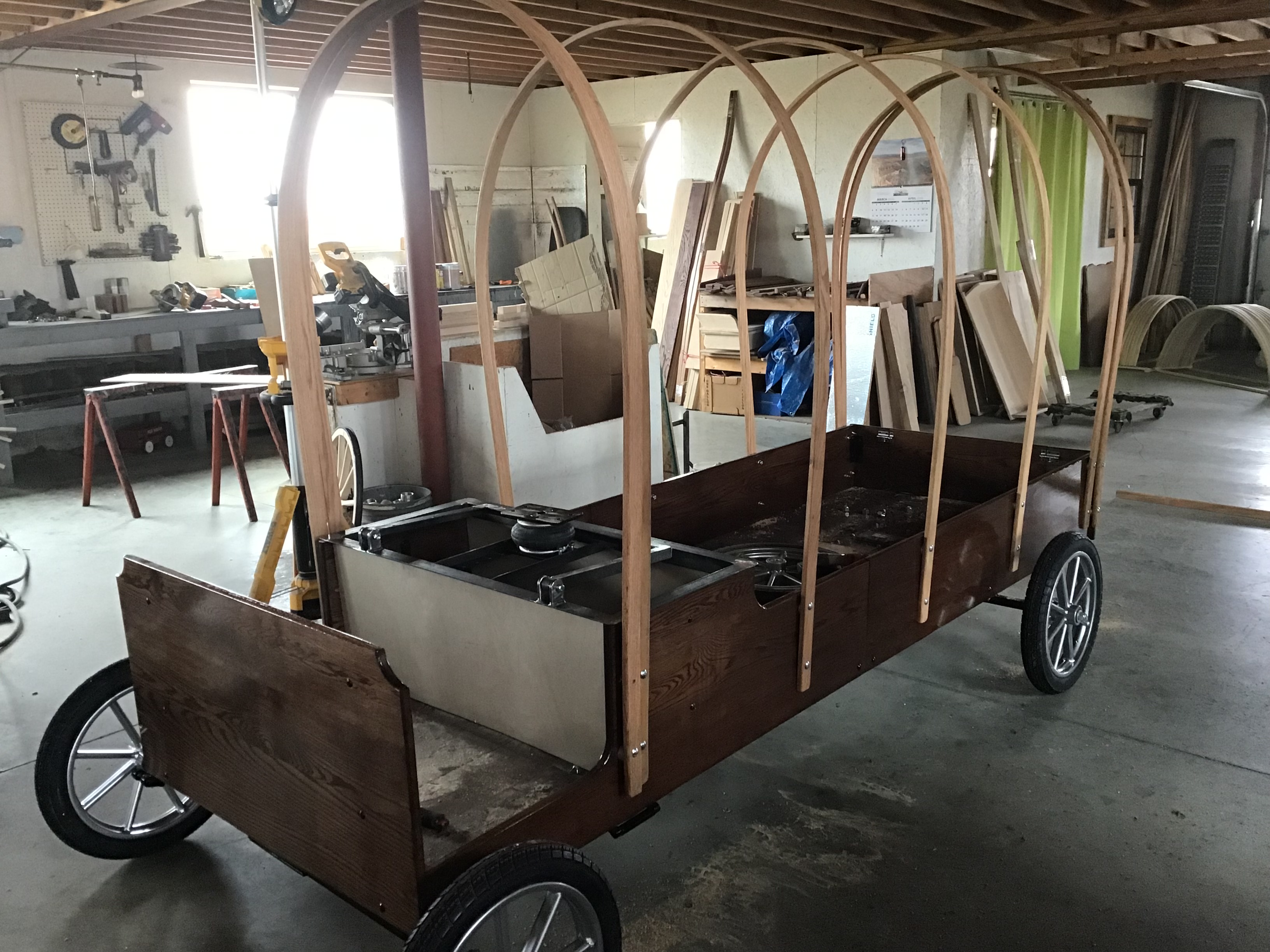
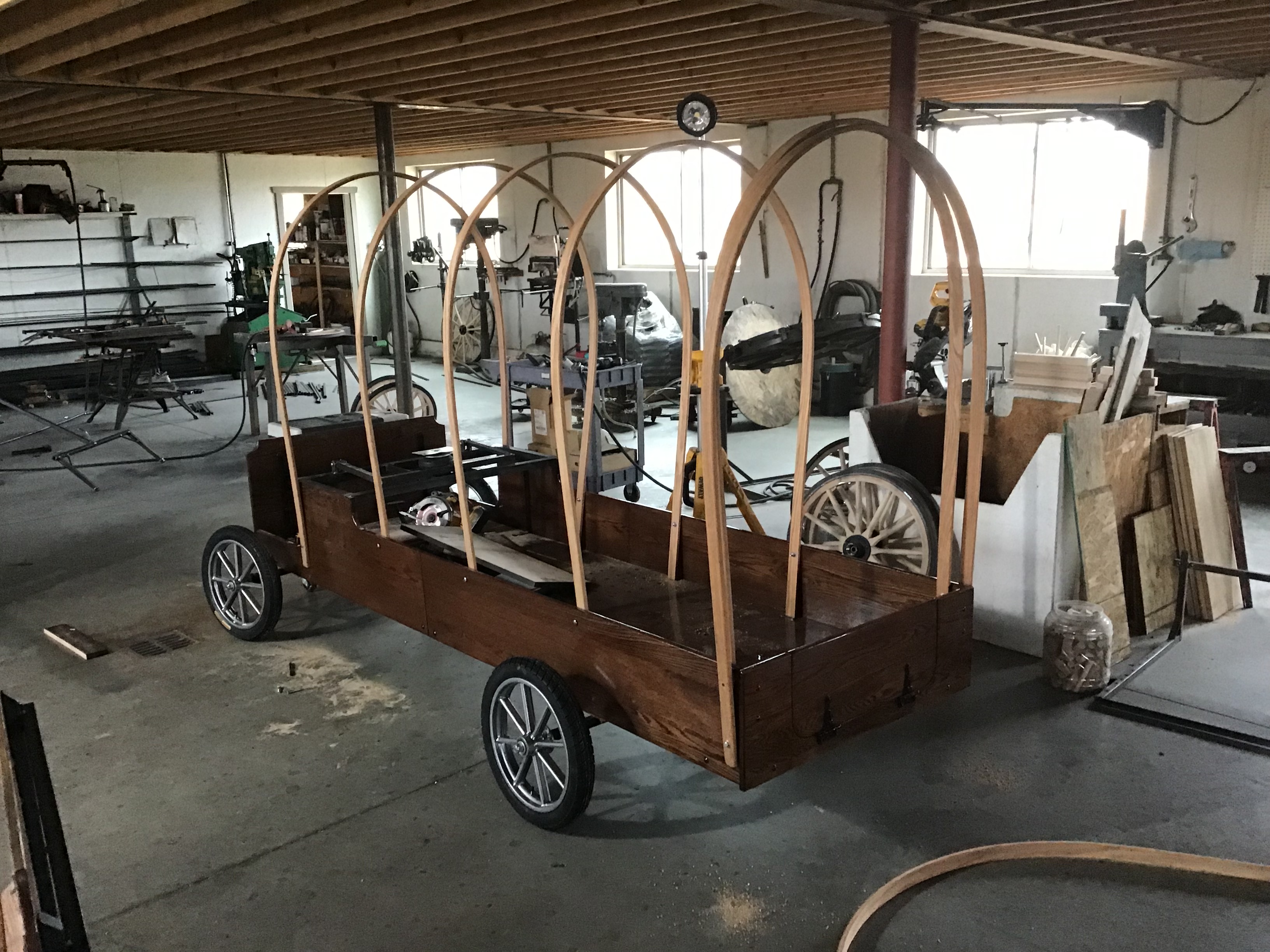
Designing the wagon with Mel of Pequea Carriage is seriously the most fun I’ve had in a long time. Starting with a dream and some basic parameters, function and aesthetics have guided each detail of the form and Mel has connected me with other craftsmen as needed to bring this project to fruition. We’ve been figuring out how to build in storage and work spaces and day/night versatility, while keeping the whole thing within the weight limit of what the ponies can handle, all while keeping an eye on balance and safety going down the road. While not every one of my ideas has been practical or possible, we’ve usually been able to figure out a work-around to accomplish the same goal.
If you look at the picture, you can see that the front and back bows are double – this is so that the canvas top can be extended at night to surround the entire front of the wagon and provide a small “alcove” in the back behind the bed of the wagon (dressing room, bad weather cooking area, space for my chamber pot at night.) The circle in the middle of the seat is an air bag suspension system – and the seat lifts up to reveal a storage area.
Meanwhile, Gin has been helping me with my social media situation long distance from Australia and I’m now back on Facebook, apparently in two places – here as Sea G Rhydr (the person) and here as Free Range Rodeo. My Instagram posts show up on the former and I’m going to try and have blog posts show up (or at least links to them) on the latter. I’ve decided to go with Barker Books for getting the book out into the world – more on that soon!
Discover more from Free Range Rodeo
Subscribe to get the latest posts sent to your email.


Love this, can’t wait to follow along😍
glad to have you along for the drive!
It sounds like you’ve got quite an adventure before you. The design and building aspect must be a great deal of fun…
i haven’t been doing any of the building myself – but the design aspect has been fascinating and yes, a great deal of fun!
Great review. Where do you start? From Pa. where the wagon was built?
Uncle Dick
The wagon is being built in Narvon, PA. It will be transported by truck to Twilight Farms in Fresno, OH. That’s where the ponies, Franklin and Theodore, are waiting for me and Thick and the wagon. We’ll head West from there.
Too cool!!!
thank you! I’m pretty excited to see it in person!
Hero
shall i get a cape?